
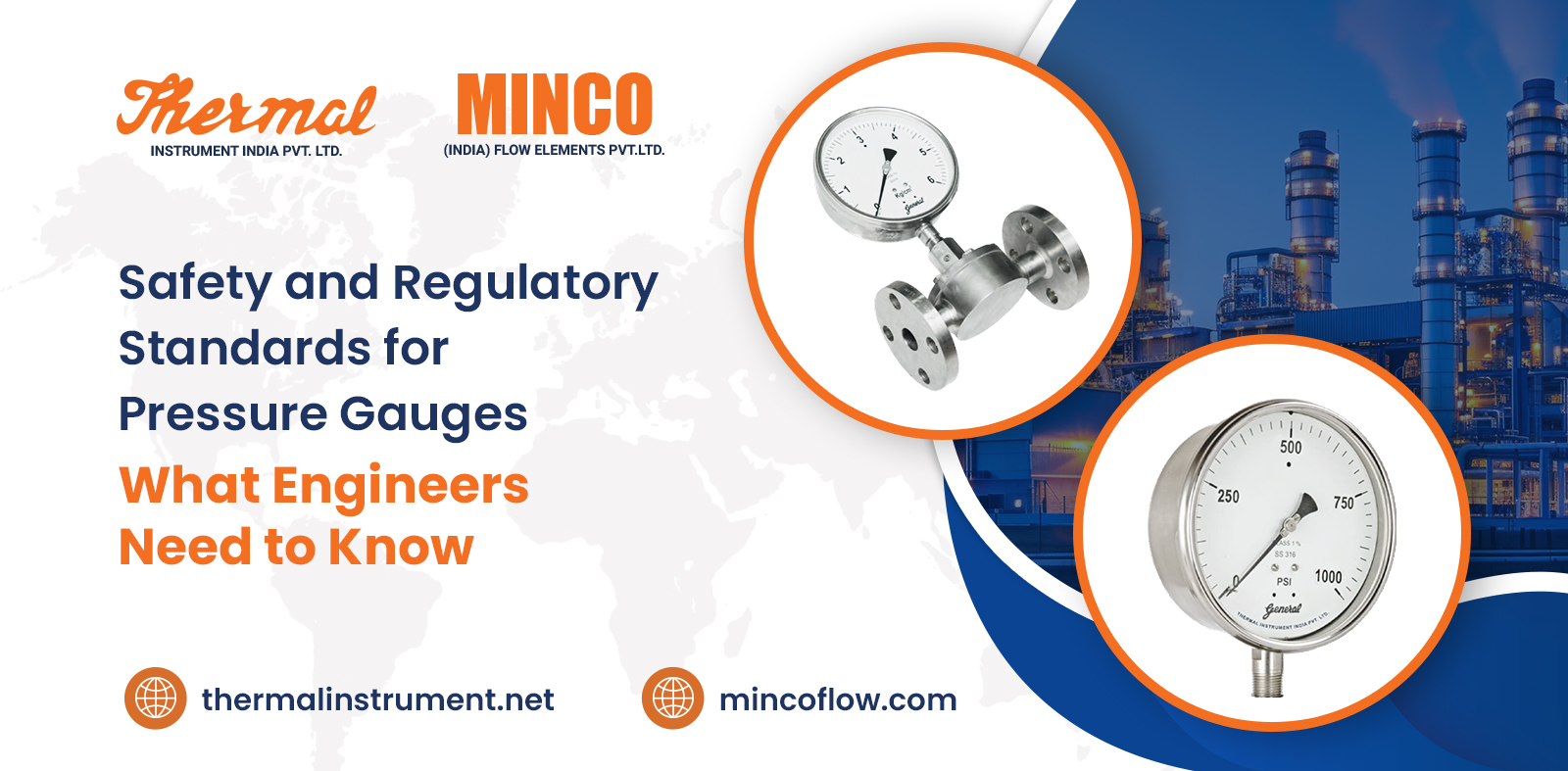
Safety and Regulatory Standards for Pressure Gauges: What Engineers Need to Know
In modern process industries, pressure gauges serve as vital instruments that ensure the safe and efficient operation of critical systems. Whether in oil & gas, chemical, or power plants, maintaining accurate pressure readings is essential to avoid equipment failure, production losses, or catastrophic accidents.
As a trusted pressure gauge manufacturer, Thermal Instruments has set benchmarks in safety and precision, providing instruments that meet stringent global standards like EN 837, ASME B40.100, and ISO 9001 compliance.
-
The Importance of Compliance and Safety in Pressure Measurement
Safety and regulatory compliance are not mere checkboxes—they are the foundation of reliable process control. Pressure gauges that conform to recognized international standards ensure:
- Operational reliability – reducing the risk of overpressure incidents.
- Measurement consistency – improving process efficiency and product quality.
- Personnel safety – minimizing hazards from pressure bursts or gauge failures.
Non-compliant gauges can cause system instability, inaccurate readings, and safety risks, especially in high-pressure environments. That’s why manufacturers like Thermal Instruments integrate safety mechanisms such as solid baffle walls and blow-out backs to protect users during unexpected pressure surges.
-
Essential Tests Defining Gauge Safety and Quality
Every gauge developed by Thermal Instruments undergoes a comprehensive set of quality assurance tests to ensure durability, stability, and accuracy under real-world operating conditions.
Core Mechanical and Accuracy Tests
- Visual & Dimensional Verification – Ensures every component meets design tolerances.
- Accuracy & Hysteresis Testing – Confirms linearity and repeatability across the full-scale range.
- Leak Test – Detects minute leaks to ensure sealing integrity.
Performance & Reliability Tests
- Vibration and Shock Tests – Simulate field conditions to assess mechanical robustness.
- Thermal Stability Tests – Evaluate performance at rated temperature extremes.
- Cyclic and Overpressure Endurance Tests – Assess resistance to continuous and fluctuating pressure loads.
Safety Validation
- Blow-out and Burst Tests – Validate the gauge’s ability to safely vent in case of Bourdon tube rupture.
- Protection Degree Testing, Confirms IP-rated enclosure protection against dust and moisture.
-
How Engineers Benefit from Standards-Based Instruments
For design and maintenance engineers, selecting a gauge that complies with international standards offers multiple benefits:
- Simplified integration with global plant systems.
- Enhanced safety certifications for audits and regulatory compliance.
- Reduced lifecycle costs through durability and long calibration intervals.
When choosing a pressure gauge manufacturer, engineers should look beyond cost and focus on certification, testing history, and material traceability, all of which Thermal Instruments provides as part of its manufacturing excellence.
Conclusion
In high-stakes process environments, pressure gauges are the first line of defense against unsafe pressure levels. Adherence to international safety and regulatory standards is essential for ensuring long-term performance, personnel safety, and process reliability.
With decades of expertise, Thermal Instruments continues to lead as a manufacturer of precision-engineered pressure gauges that embody quality, safety, and innovation, trusted by process industries worldwide for their commitment to engineering excellence.